Why Traditional Ethernet Has a Distance Limitation
Standard twisted-pair Ethernet channels are generally limited to 100 meters for a typical copper Ethernet link. When network devices must be installed hundreds of meters away from a control room, building, or network cabinet, extending connectivity becomes more complicated.Traditional deployments may require intermediate switches, additional power outlets, outdoor enclosures, and extra maintenance points. These components can increase installation costs and introduce additional failure points.
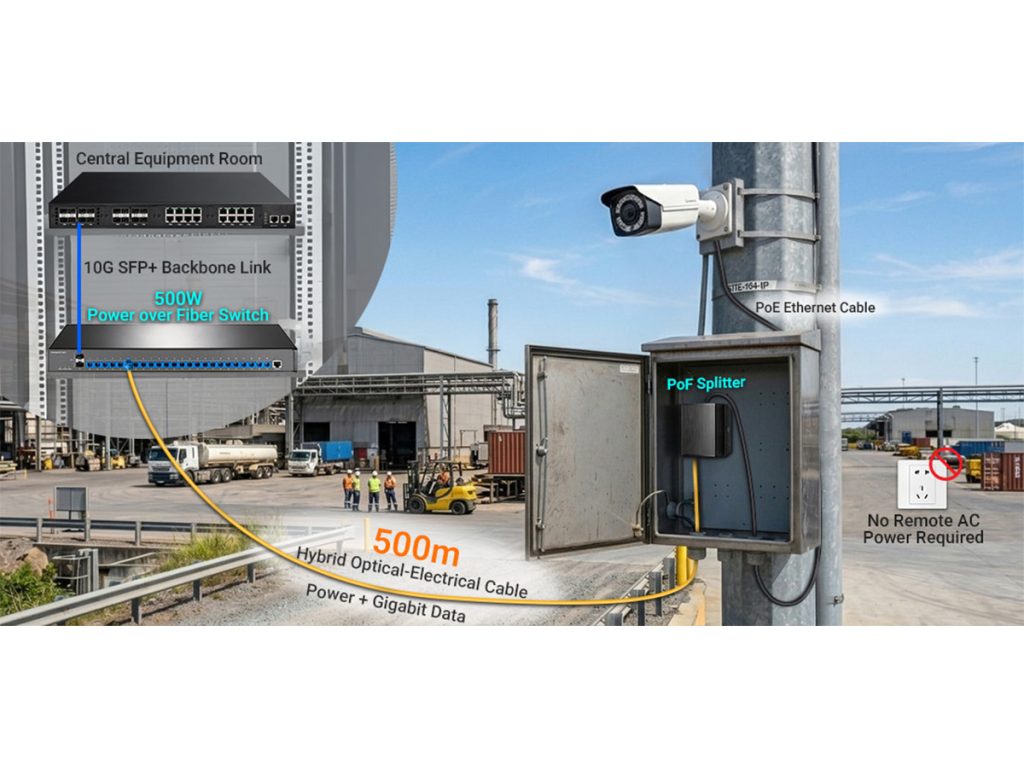
Power over Fiber (PoF) offers an alternative architecture by combining optical data transmission with a separate method of delivering electrical power over a hybrid fiber-power cable.
How Power over Fiber Works
A PoF deployment uses optical fiber to transmit network data over distances beyond the reach of a conventional copper Ethernet link. Electrical power is delivered through the power conductors integrated into a compatible hybrid cable.
At the remote end, a compatible PoF switch or power conversion system provides network connectivity for connected devices. The actual distance and available power depend on the cable design, conductor resistance, power delivery architecture, connected load, and equipment specifications.
This approach can reduce the need for intermediate network equipment when a remote location requires both data connectivity and power.
Example: A 500-Meter Remote Network
Consider a surveillance or industrial monitoring project where IP cameras, access devices, or other Ethernet equipment must be installed approximately 500 meters from the main network cabinet.A suitable PoF architecture can include:A central network or PoF switch installed in the main equipment room.A compatible hybrid fiber-power cable connecting the central and remote locations.A remote PoF-compatible switch or power conversion unit.
Ethernet connections from the remote equipment to cameras, sensors, or other network devices.
Before deployment, engineers should confirm that the complete system supports the required transmission distance, power budget, cable specifications, and remote-end equipment.
What Engineers Should Check Before Deployment
1. Total power budget
Calculate the combined power demand of all connected devices. Include cable losses, conversion losses, startup requirements, and an appropriate engineering margin. Do not assume that the switch's total power rating is the amount available at the remote endpoint.2. Cable and distance compatibility
Verify the hybrid cable's conductor size, resistance, insulation rating, optical characteristics, and approved operating distance. A 500-meter link must be validated against the specific PoF system design.3. Network bandwidth and uplinksCheck the required access-port speeds, switching capacity, and uplink bandwidth. For larger installations, 10G SFP+ uplinks can help connect the access network to an aggregation or core switch when supported by the selected equipment.
4. Environmental requirements
For industrial or outdoor deployments, evaluate operating temperature, enclosure protection, surge protection, grounding, and installation conditions. These requirements depend on the location and applicable electrical and safety standards.5. Remote monitoring and maintenance
Managed switching features, VLAN segmentation, and Layer 3 functions can help engineers organize traffic and manage network connectivity where supported by the selected model.Where PoF Can Be Useful
Power over Fiber may be considered for long-distance IP surveillance, industrial monitoring, remote access control, campus infrastructure, and other installations where conventional copper Ethernet distance limits create deployment challenges.The best architecture depends on the remote devices, required power, cable route, environmental conditions, and maintenance requirements.
Conclusion
Power over Fiber provides a practical way to combine long-distance optical networking with electrical power delivery over a compatible hybrid cable. For deployments around 500 meters, engineers should validate the power budget, cable design, transmission distance, remote equipment, and environmental requirements before selecting a system.For more technical information, explore these resources:- 500-Meter Power over Fiber Network Guide- 500W Power over Fiber Switch- Benchu Group Official Website
About Benchu Group: Benchu Group supplies industrial Ethernet switches and networking products for industrial, surveillance, and other demanding network applications.