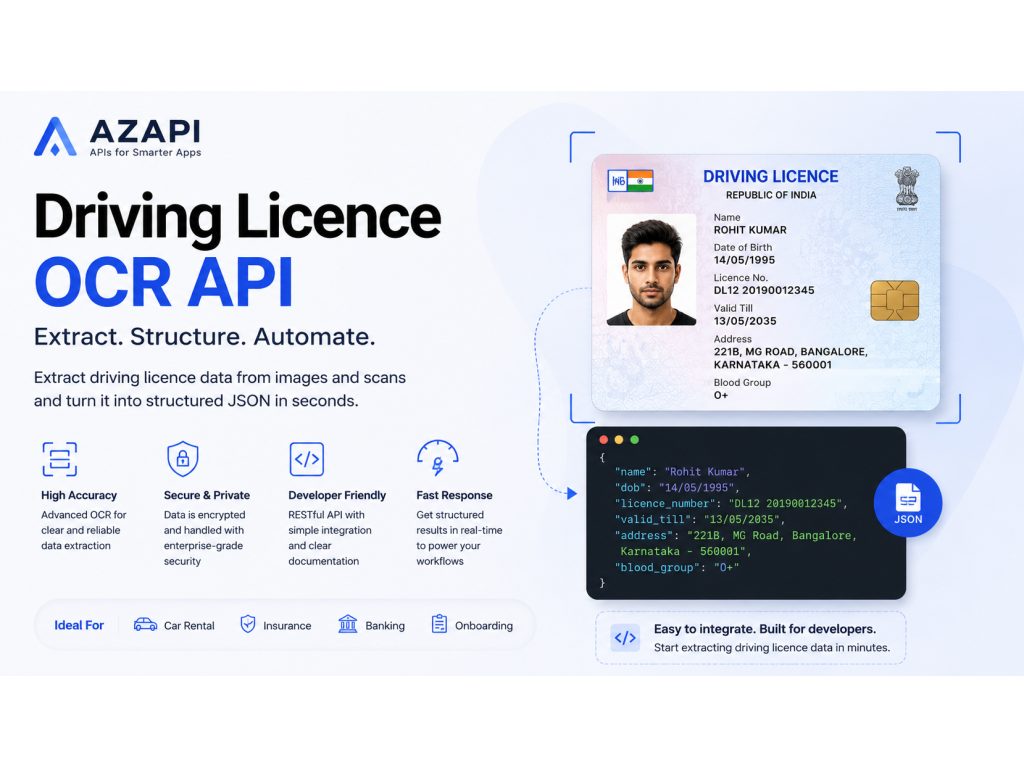
How Driver License OCR Supports Faster Identity Verification
Identity verification is an important part of many digital services. Banking applications, insurance platforms, fintech products, rental services, and online marketplaces often need users to provide an identity document before they can access a service. Driver licenses are commonly used for this purpose because they contain several pieces of information that can help identify an individual. The challenge begins when this information is provided as an image rather than as digital data. Manually reading a driver license and entering its details into an application can take time and may introduce data-entry mistakes. This is where Driver License OCR can become useful.What Is Driver License OCR?
Optical Character Recognition, or OCR, is a technology that detects and converts text from images into machine-readable information. With a Driver License OCR API, an application can send a photograph or scanned copy of a driver license for processing. The OCR system analyzes the document and extracts relevant information that can then be used by the application.Depending on the document and OCR solution, information may include:
- Full name
- Date of birth
- Address
- Driver license number
- Expiration date
- Other available document fields
Why OCR Is Useful for Identity Verification
The main advantage of OCR is not simply recognizing text. It is the ability to connect document information with an existing software workflow. For example, during online registration, a user could upload a driver license instead of typing every detail into a form. The application can process the image, receive the extracted information, and use the returned data to populate relevant fields. This can help reduce repetitive data entry and make onboarding more convenient.OCR can also be useful when businesses process a large number of documents. Automating the initial extraction step allows teams to spend less time copying information manually.
OCR and Verification Are Different
One important distinction is that OCR and identity verification are not exactly the same thing.
OCR focuses on extracting information from a document. Verification can involve additional checks to determine whether the document or the information meets the requirements of a particular workflow.
A typical system might therefore follow a process such as:
Upload document → OCR extraction → Data processing → Verification checks → Continue onboardingKeeping these stages separate can make it easier for developers to design document-processing workflows around their specific requirements.
Common Applications
Driver License OCR can be useful in several industries.
Banking and fintech: Extracting identity information during digital account opening and customer onboarding.
Insurance: Capturing customer or policyholder information from submitted documents.
Car rental: Reducing manual entry when collecting driver information before a rental.
Online platforms: Using document data as part of registration or identity-related workflows.
Digital record management: Converting information from physical or scanned documents into structured records.
Using an OCR API Instead of Building Everything Internally
Developers building document-processing systems have to consider several components, including image processing, text recognition, field extraction, API handling, and error management.
An OCR API can provide the extraction layer without requiring a team to build the complete recognition system from scratch.
For example, AZAPI's Driver License OCR API is designed to extract useful information from driver license images and scans and return it in a format that applications can work with programmatically.
The API approach can be particularly useful when document extraction needs to become part of an existing web or mobile application.
Image Quality Still Matters
OCR performance depends partly on the quality of the submitted document image.
Images that are blurry, poorly lit, heavily tilted, or affected by glare can make text recognition more difficult. Applications can therefore improve the overall workflow by asking users to capture clear images and checking basic image quality before sending documents for processing.
This is especially important in automated onboarding, where a poor-quality image can interrupt the user's journey.
Final Thoughts
Driver License OCR can simplify an otherwise repetitive part of identity-related workflows by converting information from document images into usable digital data.
For businesses processing large numbers of identity documents, automating data extraction can reduce manual work and make onboarding processes easier to manage.
The most effective implementations also treat OCR as one part of a broader verification workflow rather than assuming that extracting text alone confirms someone's identity.
Learn more about Driver License OCR API:
https://azapi.ai/services/ocr/driving-licence-ocr-api/